Two dogs meet at the park. One drops into a play bow, bounces a step sideways, then rockets off with the other in full pursuit. Ten minutes later they’ve swapped roles — the chaser is now the chased. That’s not just cute. That is two dogs negotiating a game, constantly checking in with each other, and keeping the whole thing fun.
Reading that negotiation — knowing when play is healthy and when it’s sliding toward trouble — is one of the most useful skills a dog owner can build. Here’s how dog body language tells the story.
Healthy dog play: what it looks like
Good play is loose, bouncy, and full of choice. Watch a pair of dogs who are enjoying each other and you’ll see the same markers over and over:
The play bow
Front end down, rear up, tail wagging wide. This is the universal “this is still a game” signal. Dogs bow before play, during play, and right after a pause that might have gotten too intense. When a dog re-invites with a bow after a break, that’s a dog saying yes, again — and meaning it.
Role reversals
Healthy playmates take turns. The big dog lets the small one win. The chaser becomes the chased. The dog who had the toy last lets the other have it now. Constant, natural switching means both dogs feel like equals — nobody is stuck in the loser role.
Self-handicapping
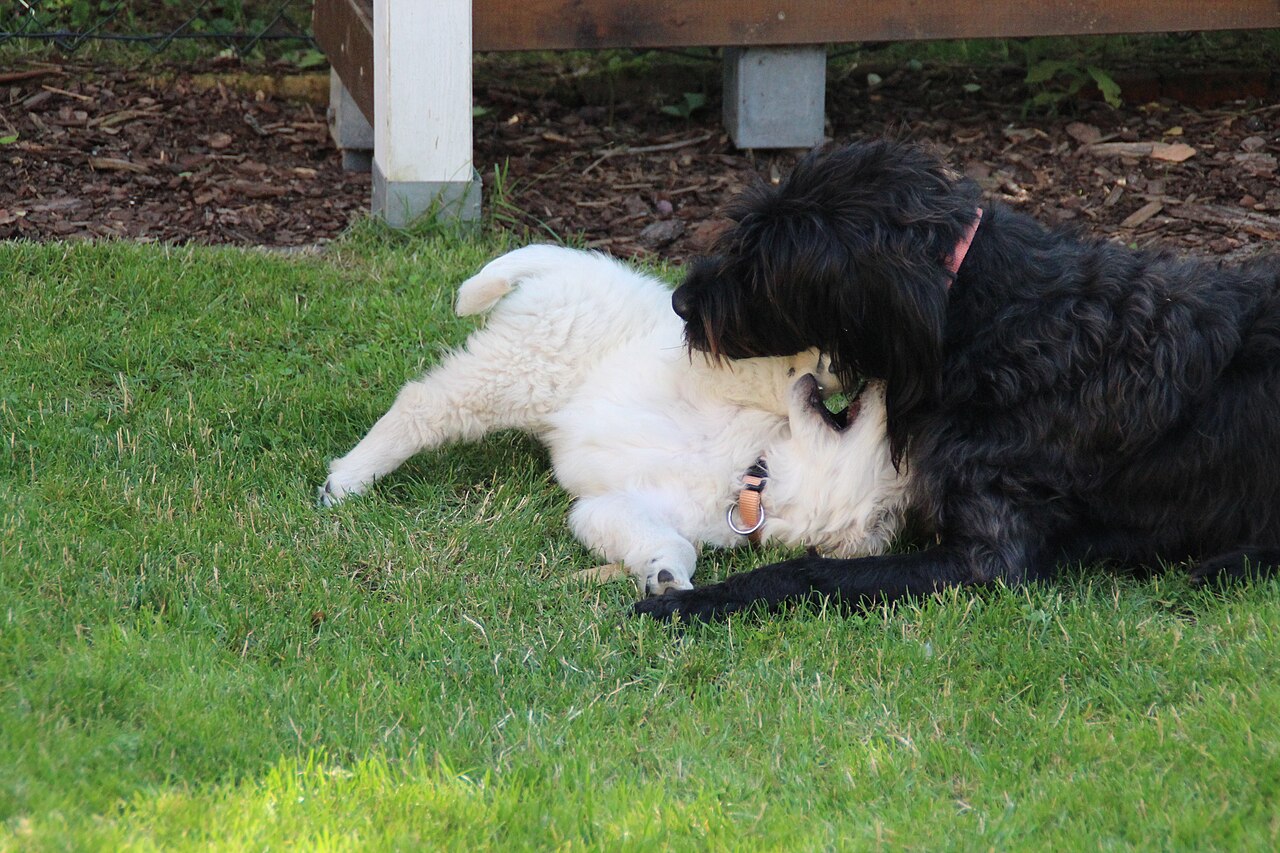
A larger or more confident dog deliberately holds back: slower movement, softer bites, play that stops when the smaller partner gets overwhelmed. You’ll see a big dog flop onto its belly so a puppy can “attack” from above. That restraint is the hallmark of safe, compatible play.
Breaks the dogs take themselves
Well-matched dogs pause on their own — a sniff of the ground, a shake-off, a quick drift apart, then another bow and they’re off again. Intermittent pauses reset arousal and keep the game from boiling over. Dogs who can self-regulate like this almost never need human rescue.
Red flags: when play is going wrong
Problems rarely start with a bite. They start with body language that stops looking playful:
- Stiffness. Loose, wiggly bodies turn rigid and tall. Height — a dog body-slamming another dog flat or mounting repeatedly — shifts play into something else.
- One-way pursuit. Play chases have reversals. A dog who only ever flees, tail tucked and low to the ground, isn’t playing anymore.
- Pinning and blocking. One dog cornering another, standing over it, or refusing to let the game pause.
- Silence that turns to sound. Play growls are high-pitched and flexible. Deep, escalating growls paired with hackles and a hard stare deserve an immediate interruption.
- No re-engagement. If a dog who was paused keeps avoiding the play bow — no re-invitation, no bounce — the game is over in that dog’s mind.
If you see these, interrupt calmly: call your dog over, take a leashed walk-break, or simply leave. Don’t just “wait and see” — arousal climbs fast, and the second escalation is usually much worse than the first.
Why matching matters as much as manners
A perfectly polite dog can still be a bad playmate if the size, energy, and style gap is too wide. A 75-pound young dog who plays full-contact body-slam isn’t being mean — but paired with a 10-pound senior, he’s dangerous by accident alone. Good playgroups are built by placing dogs with compatible playmates based on size, temperament, energy level, and play style, then supervising closely so the group stays fun for everyone.
That’s also why supervision is not optional at a busy play area. Human eyes catch the stiff posture or the one-way chase across the room long before things escalate, and can separate dogs with a distraction instead of a scuffle.
What this looks like on Long Island in October
Here’s the seasonal wrinkle: as days shorten and evenings cool off, the easy outlets start shrinking. The well-lit park visit happens in the dark after work. Rainy weeks turn yards into mud. Dogs who were burning energy outside all summer suddenly have a surplus — and surplus energy is where rough, sloppy play begins.
Indoor, climate-controlled play is the fix. A supervised 90-minute play session gives your dog real exercise and real dog-social time, rain or shine — while experienced handlers keep the group matched and the games fair. Daycare adds structure on busy days, so your dog comes home tired and settled instead of bored and wired.
The takeaway
Watch for loose bodies, bows, turn-taking, and self-timed breaks — those are the thumbs-up of dog play. Watch for stiffness, one-way chases, pinning, and silence from the fleeing dog — those are your cue to step in. If you’re not sure whether two dogs are matched, you’re better off starting in a supervised setting than testing it at the park alone.
Want to see healthy play up close? Bring your dog for a 90-minute supervised play session at our indoor dog park in Woodmere — rain or shine, every session watched by our team. Have questions about your dog’s play style first? Get in touch with Fido Fitness Club — we’re happy to talk it through.